I’m at a crossroads. I’m only 20. a How in the world am I expected to choose what to do for the rest of my life?
After changing my major 6 times, shadowing doctors and physician assistants for 100+ hours, researching in a mad scientist’s lab, volunteering at the nonprofit shelters and clinics, and working as a pharmacy technician, I finally decided. I wanted to become a dentist. I didn’t have an “aha!” moment. I didn’t grow up and “knew I wanted to become a doctor since I was 6.” I didn’t have parents who were doctors. I was simply a regular citizen with a regular goal: going to college and getting a job. So, how did I find out what I wanted to become?

The number one advice that was given to me by my pre-health adviser was: Journal. Document your experiences in healthcare. What did you learn? What do you want to learn? How did this experience make you feel? Do you see yourself doing this in the future? Are you excited? Are you nonchalant? What makes your spirit jump?
I knew I liked science, I knew I liked art, and I knew I like solving complex problems. I knew I wanted to help people and change the world. From this, I narrowed my paths to healthcare. This is where my undergraduate major changed 6 times. As I shadowed doctors and dentists, I journaled. After 3 years, I pulled out this raggedy, coffee-stained journal and this is what I found that resonated with me the most:
Why I chose dentistry:
- Artist, engineer, scientist all-in-one
- Hands-on work
- Direct patient care, extensive patient relationships
- No two patients are the same
- Improve peoples’ appearance, self-confidence, & self esteem
- Bodily hygiene/health begins with oral hygiene/health
- Able to practice preventative care
- Able to practice cosmetics
- Immediate impact on patient, see results asap
- Able to educate others
- Demand for minority dentists
- Demand for dentists in underserved areas
- Freedom; able to decide your plan of care
- Not as constrained by insurance
- Ability to change lives
I read a fellow dental student’s perspective on dentistry, and he said that dentistry is not life-saving, but rather life-changing. “Dentists work in the millimeters, yet through this work they change lives indisputably at a greater level.”
With choosing dentistry, you have to consider what a career in dentistry may cost. There is a huge time investment when it comes to any healthcare profession, for studying and for paying debts. The cost of the DAT is $475, and the average student applying to 8-12 dental schools cost about $1,400. The average total cost for in-state dental students is $251,000, and for out-of-state students, the average total cost is $322,000 (according to 2019 figures). However, in my humble opinion, this is a small price to pay when you get to practice in a field that you’re passionate about (and get paid for it).
In dentistry, there are a number of specialties and routes you can take after completing dental school:
- Endodontists (root canal specialist)
- Oral and maxillofacial surgeon
- Orthodontist (alignment specialist)
- Pediatric dentist (children specialist)
- Periodontist (gum specialist)
- Prosthodontist (replacement specialist)
So, how do you get into dental school? Here’s a summarized timeline:
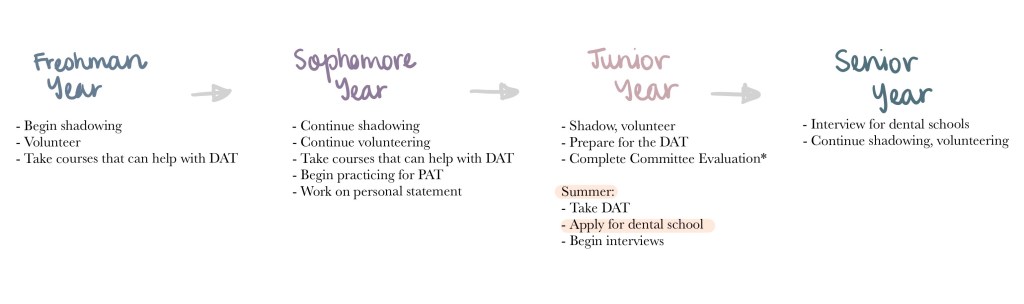
To study for the DAT, I used only one source: DAT Bootcamp. This source was all I needed to achieve a 20. There are many other students who used this resource and got higher scores. DAT Bootcamp offers free study notes and PAT practice. A subscription only lasts 90 days, so I bought a subscription 90 days before I took the DAT.
After taking the DAT, I applied to schools and began interviewing into and throughout my senior year of college. Dental schools offer acceptances on a rolling basis after the first round of acceptances in early December. I also continued to shadow and volunteer to bolster my application in the event that I didn’t get in during this cycle.
However, with COVID-19 still touring the streets of the United States, there has already been major changes to this year’s application cycle. Prometric Test Centers have been closed, and many people’s DAT exams have been rescheduled into August and September. Dental schools have been cutting their required shadowing hours and have turned to online interviews for the rest of this year’s cycle. Although AADSAS (the dental school application portal) is still scheduled to open on regular time, there is a lot of confusion and speculation as to how soon applicants are going to be able to submit. Normally, an applicant will submit early on, after taking their DAT. Now, with a lot of exams pushed back, I suspect that next year’s cycle may be a little later and take longer to fill.
However, in the midst of this confusion and uncertain time, this situation can bring light to prospective dental students and how dentistry can operate in a time like this. Dental offices are still open to emergencies, and some dentists and residents are even volunteering at testing sites, hospitals, and urgent cares to administer their knowledge in medicine and health. Additionally, prospective students will be able to see which dental schools are accommodating to their students and hard times vs. dental schools that are not offering help.
This pre-dental journey is based off of my experience. Don’t hesitate to contact me if you have any questions or concerns!
 Study Tea